PCA on food texture#
A small dataset where five sensory and instrumental measurements are taken on each of 50 pastry samples: oil percentage, density, crispiness, fracture force, and hardness. The variables are correlated and measured on different scales, so PCA on the autoscaled data shows the dominant patterns in two components and lets us identify samples that do not look like the rest of the batch.
Data. food-texture.csv from openmv.net. The first column is a sample identifier; the remaining five are the measurements.
Adapted from the Principal Component Analysis chapter of the Process Improvement using Data book (CC BY-SA 4.0).
[1]:
import matplotlib.pyplot as plt
import pandas as pd
import plotly.io as pio

from process_improve.multivariate.methods import PCA, MCUVScaler

pio.renderers.default = "notebook_connected"
Load the data#
[2]:
foods = pd.read_csv("https://openmv.net/file/food-texture.csv", index_col=0)
print(f"Shape: {foods.shape[0]} samples x {foods.shape[1]} variables")
foods.head()
Shape: 50 samples x 5 variables
[2]:
| Oil | Density | Crispy | Fracture | Hardness | |
|---|---|---|---|---|---|
| B110 | 16.5 | 2955 | 10 | 23 | 97 |
| B136 | 17.7 | 2660 | 14 | 9 | 139 |
| B171 | 16.2 | 2870 | 12 | 17 | 143 |
| B192 | 16.7 | 2920 | 10 | 31 | 95 |
| B225 | 16.3 | 2975 | 11 | 26 | 143 |
[3]:
foods.describe().round(2)
[3]:
| Oil | Density | Crispy | Fracture | Hardness | |
|---|---|---|---|---|---|
| count | 50.00 | 50.0 | 50.00 | 50.00 | 50.00 |
| mean | 17.20 | 2857.6 | 11.52 | 20.86 | 128.18 |
| std | 1.59 | 124.5 | 1.78 | 5.47 | 31.13 |
| min | 13.70 | 2570.0 | 7.00 | 9.00 | 63.00 |
| 25% | 16.30 | 2772.5 | 10.00 | 17.00 | 107.25 |
| 50% | 16.90 | 2867.5 | 12.00 | 21.00 | 126.00 |
| 75% | 18.10 | 2945.0 | 13.00 | 25.00 | 143.75 |
| max | 21.20 | 3125.0 | 15.00 | 33.00 | 192.00 |
The five variables span very different ranges (oil percentage is in the teens, density is in the thousands, the rest are unitless sensory scores). Without scaling, density would dominate the model purely through its variance.
Preprocess and fit#
Two different inputs, deliberately. PCA.select_n_components gets the raw foods: it cross-validates by holding out individual cells, and its default scale_inside_folds=True fits the scaling separately inside each fold so that a held-out cell never influences its own prediction. The model itself is then fitted on the autoscaled X.
[4]:
X = MCUVScaler().fit_transform(foods)

selection = PCA.select_n_components(foods, max_components=4, cv=5)
print(f"Recommended A = {selection.n_components}")
selection.press_ratio.round(3)
Recommended A = 2
[4]:
n_components
2    0.770
3    2.072
4    1.009
Name: PRESS ratio, dtype: float64
[5]:
model = PCA(n_components=max(2, selection.n_components)).fit(X)
model.r2_cumulative_.round(3)
[5]:
1    0.606
2    0.865
Name: Cumulative R², dtype: float64
Score and loading plots#
With only five variables, the loading plot is more useful than for high-dimensional spectra: every loading carries a recognisable label, and we can read directly which sensory and instrumental measurements drive each component.
[6]:
model.score_plot()
[7]:
model.loading_plot()
SPE and Hotelling’s T squared#
[8]:
model.spe_plot()
[9]:
model.t2_plot()
Outlier explanation#
Each flagged sample can be explained back in terms of the original five variables with score_contributions. A score is a weighted sum of the variables, so it splits into one term per variable, x_ik * p_ka, and those terms add back up to the score. Note that this is not the loading plot: a variable with a large loading contributes nothing to a sample sitting at its mean, so the ranking here is specific to this sample.
[10]:
outliers = model.detect_outliers(conf_level=0.95)
print(f"{len(outliers)} samples flagged")
for o in outliers[:3]:
    print(f"  {o['observation']}: {o['outlier_types']} (severity={o['severity']:.2f})")
3 samples flagged
  B575: ['spe'] (severity=1.36)
  B485: ['spe'] (severity=1.10)
  B758: ['hotellings_t2'] (severity=1.01)
[11]:
if outliers:
    worst = outliers[0]["observation"]
    contrib = model.score_contributions(X, component=1).loc[worst]

    fig, ax = plt.subplots(figsize=(6, 3))
    contrib.plot.bar(ax=ax, color="steelblue")
    ax.axhline(0, color="k", linewidth=0.5)
    ax.set_ylabel("Contribution to $t_1$")
    ax.set_title(f"Score contributions for sample {worst}")
    plt.tight_layout()
    plt.show()

    print(f"contributions sum to {contrib.sum():.4f}")
    print(f"score t1 for this sample is {model.scores_.loc[worst, 1]:.4f}")
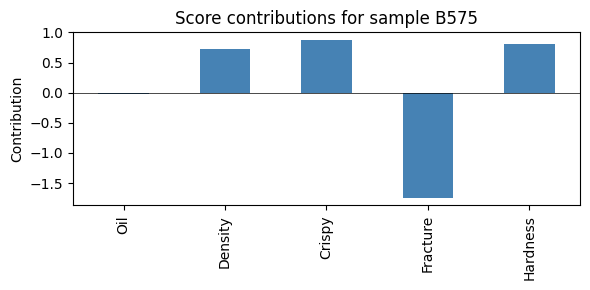
contributions sum to -1.1107
score t1 for this sample is -1.1107
What to try next#
The food-texture dataset is small enough that you can recompute everything by hand and check intuition. Try changing the number of components and watch what happens to the score plot, the SPE limit, and the list of flagged samples.
Compare the loading plot against domain knowledge: do the variables that cluster together in the loading plot also correlate strongly in
foods.corr()?Once a property like consumer acceptance is added, switch to PLS to relate the texture variables to it.