

Design families and how each one is checked#
Every design below comes from one call, generate_design(factors, design_type, ...).
Each construction is checked against its published definition by a test class in
tests/test_doe_conformance.py,
so a change that breaks the defining property fails the test suite.
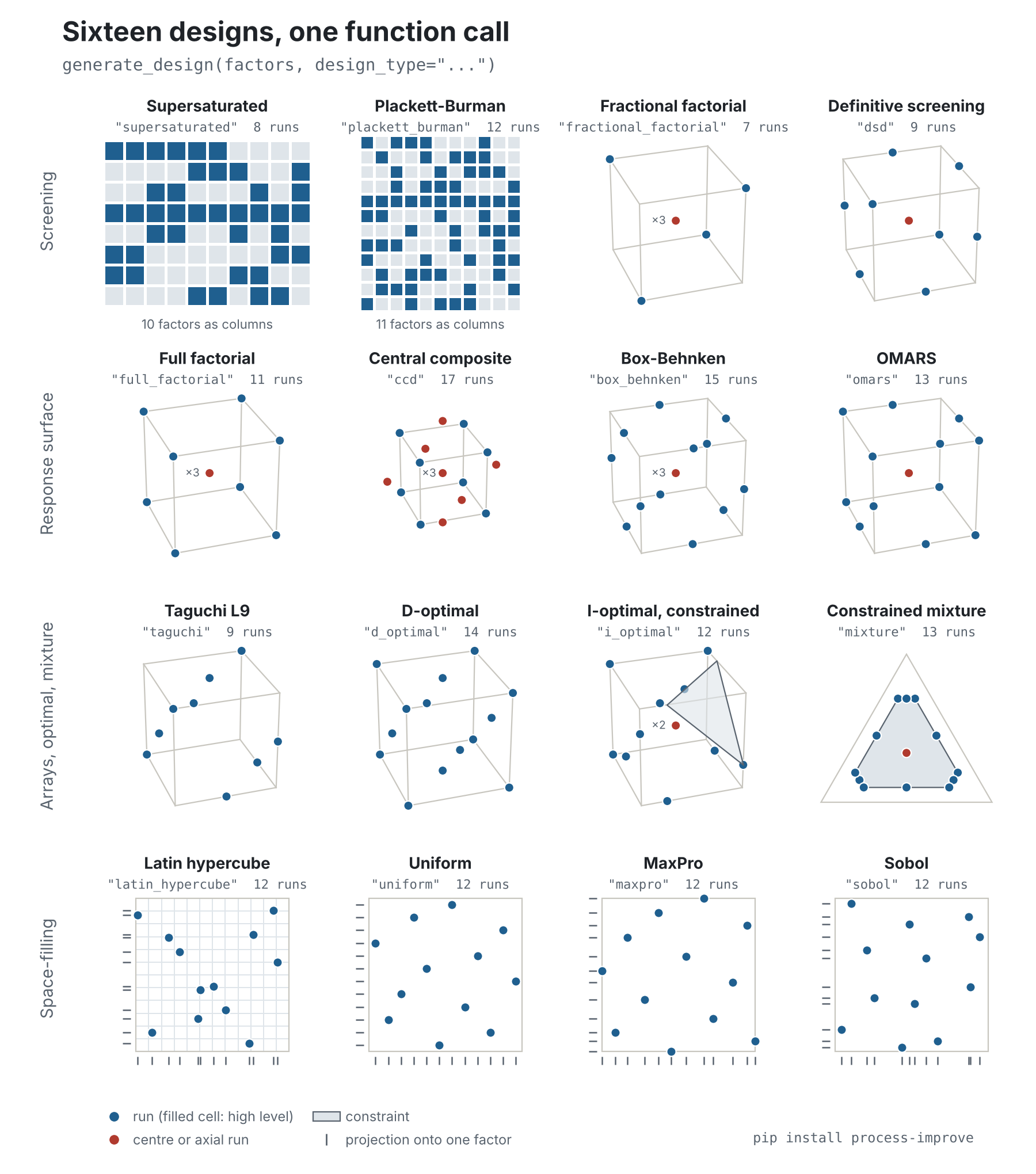
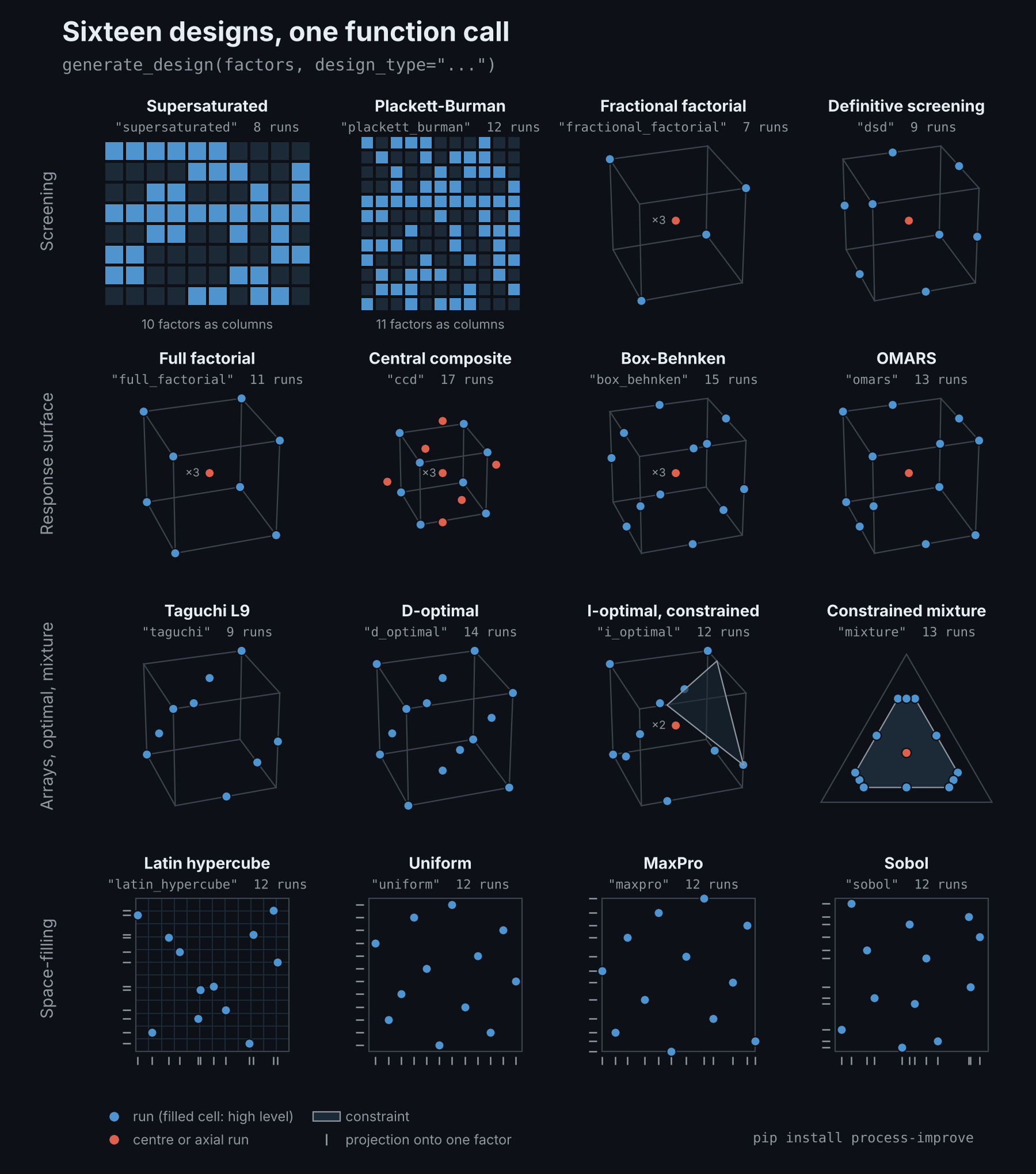
The script that draws the gallery, tools/branding/design_gallery.py, makes every design in it
with one generate_design call.
Family |
|
Defining property checked |
Test class |
|---|---|---|---|
Full factorial, two-level and mixed-level |
|
Every combination of levels exactly once, two-level and mixed-level |
|
Fractional factorial |
|
Resolution and run count of the minimum-aberration fraction |
|
Plackett-Burman |
|
Columns of a Hadamard matrix: \(H'H = N I\) |
|
Definitive screening (DSD) |
|
Conference matrix \(C'C = (m-1) I\), foldover, main effects orthogonal to every second-order term; fake factors from a run budget |
|
Supersaturated |
|
Balanced columns, \(E(s^2)\) at or near its lower bound |
|
Taguchi orthogonal array |
|
Strength 2: every pair of columns balanced |
|
Box-Behnken |
|
Published run counts (Box and Behnken 1960), including the 6- and 7-factor designs |
|
Central composite (CCD) |
|
Rotatable \(\alpha = F^{1/4}\); orthogonal \(\alpha\) makes the quadratic columns orthogonal |
|
OMARS |
|
Main effects orthogonal to each other and to every second-order term |
|
Mixture: simplex and extreme vertices |
|
Simplex-centroid size \(2^q - 1\); every blend sums to 1 and respects its bounds |
|
D-, I-, A- and E-optimal |
|
Runs satisfy the constraints; each criterion is best on its own measure |
|
G- and K-optimal |
|
Best G-efficiency and smallest condition number; the \(2^k\) factorial is G-optimal for a first-order model |
|
Space-filling |
|
One run per slice (Latin hypercube), spread, discrepancy, Sobol balance, MaxPro projections in constrained and mixture regions |
|
Blocking (n_blocks) is checked separately in tests/test_blocking.py: a
two-level factorial is blocked by confounding high-order interactions, so main
effects and unconfounded two-factor interactions keep their full information; a
central composite design is blocked by its cube and axial portions, orthogonally to
every term of the quadratic model with the default axial distance; other designs
are blocked by exchange.